
Blog
Donating a Boat to Charity: How the IRS Determines Your Tax Deduction Value
Donating a boat to charity can produce a real tax deduction, but the IRS ties that number to the boat's actual condition, not a guidebook guess. This guide walks through how fair market value is determined, when a qualified appraisal is required, and what happens if the charity sells the boat instead of keeping it.
Boats are different from most charitable donations. A used car can often be valued off a pricing guide, but a boat's value swings wildly based on things a guide can't see: hull condition, engine hours, electronics, rigging, and whether the vessel actually runs. The IRS knows this, which is why boat donations carry some of the more specific valuation and documentation rules in the charitable contribution code.
If you're planning to donate a boat this year, or you're a CPA helping a client through one, this article covers how the IRS expects fair market value to be determined, when a qualified marine survey appraisal becomes mandatory, and the penalty exposure if the claimed value doesn't hold up.
What the IRS Actually Values When You Donate a Boat
The IRS measures a donated boat's value at fair market value (FMV): the price a willing buyer would pay a willing seller, with neither party under pressure to act and both reasonably informed about the boat's condition. That's the standard laid out across the IRS's guidance on determining the value of donated property.
This is not the same as the boat's insured value, its original purchase price, or the payoff balance on a loan. It's also not necessarily what a dealer's retail guide shows, since those figures often reflect a dealer's asking price rather than what a private buyer would actually pay. Resale guides and online boat value estimators can give you a ballpark, but the IRS wants a figure grounded in the boat's actual facts: its true condition and comparable private-party sales, not a generic lookup number.
Why Physical Condition Drives a Boat's Appraised Value
Condition is not a minor adjustment to a boat's value; it is often the deciding factor. The IRS says so directly:
"Except for inexpensive small boats, the valuation of boats should be based on an appraisal by a marine surveyor because the physical condition is so critical to the value." - IRS Publication 561
That single sentence shapes the entire process for anyone donating a boat worth more than a few hundred dollars. A pricing guide can tell you what a similar model sold for last year. It can't tell you whether the hull has been structurally repaired, whether the engine hours point to a motor near the end of its service life, or whether the electronics and rigging are original or recently replaced. Those facts move the number, sometimes by tens of thousands of dollars on larger vessels.
Key takeaway: Once a boat moves beyond the "inexpensive small boat" category, a generic value estimate isn't enough. The IRS expects an appraisal grounded in a physical inspection of the actual vessel.
The Qualified Vehicle Rules: Form 1098-C and the Gross Proceeds Limit
Boats fall under the IRS's qualified vehicle donation rules, the same framework that governs donated cars and airplanes. Once your claimed deduction for a donated boat exceeds $500, the charity must provide you with a contemporaneous written acknowledgment, typically Form 1098-C, before you can claim the deduction. The IRS Form 8283 instructions specifically list a boat as a qualified vehicle for this purpose.
This is where boat donations diverge from most other property gifts. For a qualified vehicle, the deduction is generally capped at the gross proceeds the charity receives when it sells the boat, not the boat's appraised FMV. If the charity sells your donated 32-foot cruiser for $18,000, your deduction is generally $18,000, even if an appraiser would have valued it at $24,000.
There are exceptions. The IRS's charitable contribution rules allow you to claim FMV instead of sale proceeds if the organization:
- Makes significant intervening use of the boat before selling it (using it for sailing lessons or on-water training, for example)
- Materially improves the boat before selling it
- Gives or sells the boat at a price significantly below fair market value to a needy individual, in furtherance of the organization's charitable purpose
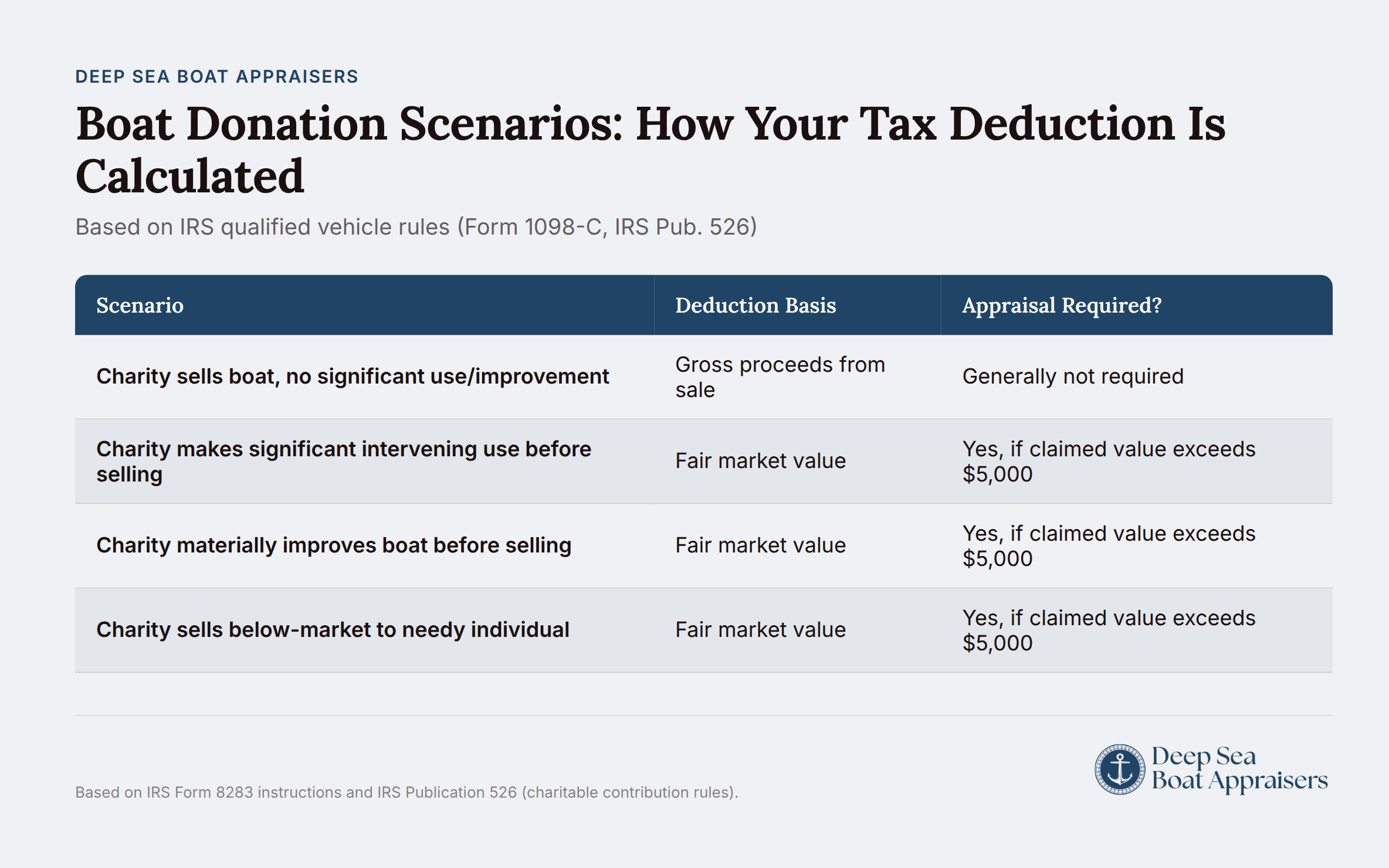
The table below shows how the outcome changes depending on what the charity actually does with the boat.
| Scenario | Deduction basis | Qualified appraisal required? |
|---|---|---|
| Charity sells the boat with no significant use or improvement | Gross proceeds from the sale | Generally not required for the capped amount |
| Charity makes significant intervening use before selling | Fair market value | Yes, if claimed value exceeds $5,000 |
| Charity materially improves the boat before selling | Fair market value | Yes, if claimed value exceeds $5,000 |
| Charity sells at below-market price to a needy individual | Fair market value | Yes, if claimed value exceeds $5,000 |
Pro tip: Ask the charity upfront what it plans to do with the boat. If they intend to sell it immediately, your deduction will likely be capped at sale proceeds regardless of what an appraisal says, so it may not make sense to pay for a full appraisal before donating.
When You Need a Qualified Appraisal
A qualified appraisal becomes mandatory once your claimed deduction for the boat exceeds $5,000, assuming you're claiming FMV under one of the exceptions above rather than the capped gross-proceeds amount. At that threshold, you must also complete Section B of Form 8283, and the charity generally has to sign the appraisal summary acknowledging receipt of the property.
If the claimed deduction exceeds $500,000, the rules tighten further: you must attach the full qualified appraisal document to your tax return, not just the appraisal summary on Form 8283. This applies to larger commercial or luxury vessels where the appraised value climbs well past the ordinary range.
The $5,000 threshold and the appraiser-qualification requirement both trace back to the charitable contribution rules in the Internal Revenue Code, which direct that appraisals supporting claims over $5,000 be prepared by a qualified appraiser using generally accepted appraisal standards.
What a Qualified Appraisal Report Must Include
A qualified appraisal isn't just a number on letterhead. Treasury regulations spell out specific content requirements, and the regulation defining a qualified appraisal requires the report to address:
- A sufficiently detailed description of the boat, including make, model, year, hull identification number, and equipment
- The boat's physical condition at the time of the appraisal
- The valuation effective date and the date of the appraisal itself
- The boat's fair market value as of the contribution date
- The valuation method used and the basis for the conclusion
- The appraiser's qualifications, including relevant experience and credentials
The appraisal must be signed and dated no earlier than 60 days before the contribution date, and generally no later than the date the return is filed. A report missing any of these elements risks being disqualified entirely, which can unwind the deduction even if the underlying value was reasonable.
The Cost of Overstating Your Boat's Value
Inflating a boat's claimed value isn't a victimless shortcut. The tax code applies accuracy-related penalties when a claimed value turns out to be substantially wrong. If the claimed value is at least 150% of the correct value and results in an underpayment, a 20% penalty applies to that underpayment. If the claimed value reaches 200% of the correct value, the penalty jumps to 40% as a gross valuation misstatement.
Watch out: These penalties apply on top of the disallowed deduction itself. A donor who claims $40,000 on a boat an appraiser would have valued at $18,000 isn't just losing the extra deduction; they're also facing a substantial penalty on the resulting underpayment.
Finding a Qualified Marine Appraiser
Our appraisers include marine surveyors who handle exactly the kind of inspection Publication 561 points to for boats above the inexpensive small-boat threshold. We've appraised donated vessels ranging from small cabin cruisers headed to sailing schools to larger pleasure and commercial craft donated to maritime nonprofits, and in every case the report comes down to the same physical facts: hull integrity, engine hours, electronics, rigging condition, and recent maintenance history.
Engagements are quoted as a fixed fee once we understand the scope of the boat and the intended use of the report. For a standard boat appraisal, fees start at $195; for an IRS-qualified appraisal built to meet the Form 8283 Section B and Treasury regulation requirements described above, fees start at $295. Larger or more complex vessels, including commercial craft or boats with disputed condition issues, fall into a higher range depending on the depth of inspection required. You'll always know the fee before work begins; nothing is billed by the hour.
Protect Your Deduction Before You Donate
A boat donation can be a meaningful charitable gift and a legitimate tax deduction, but the value you claim needs to survive scrutiny. That means understanding whether your deduction will be capped at the charity's sale proceeds or whether an exception opens the door to claiming fair market value, and if it's the latter, getting a qualified appraisal that actually documents the boat's condition rather than guessing from a pricing guide.
This article is provided for general informational purposes only and does not constitute legal, tax, or financial advice. Readers should consult a qualified attorney or CPA regarding their specific circumstances.