
Blog
How Equipment and Accessories Affect a Boat's Appraised Value
Not every upgrade adds dollar-for-dollar value in a boat appraisal: trailers get their own value line, electronics are judged on contributory value rather than replacement cost, and loose gear only counts if it's present at inspection. This guide shows owners what to document before the appraiser arrives.
A boat's sticker price rarely equals the sum of everything bolted, wired, or stowed onto it. When our appraisers inspect a vessel, every piece of equipment gets sorted into one of two buckets: part of the vessel's value, or a separate item that only counts if it's physically present and verified. Understanding that distinction before a professional boat appraisal saves owners from assuming a recent upgrade will show up as a dollar-for-dollar bump in the final report.
This matters whether the appraisal supports an insurance policy, a sale, an estate settlement, or a loan application. The intended use doesn't change the underlying logic: equipment adds value only to the extent the market recognizes its utility, condition, and remaining useful life. A $6,000 chartplotter installed three years ago does not automatically add $6,000 to the boat's value, and a trailer sitting in the driveway doesn't count at all if it isn't the one that comes with the sale.
Fixed Equipment vs. Loose Gear: What Counts Toward Value
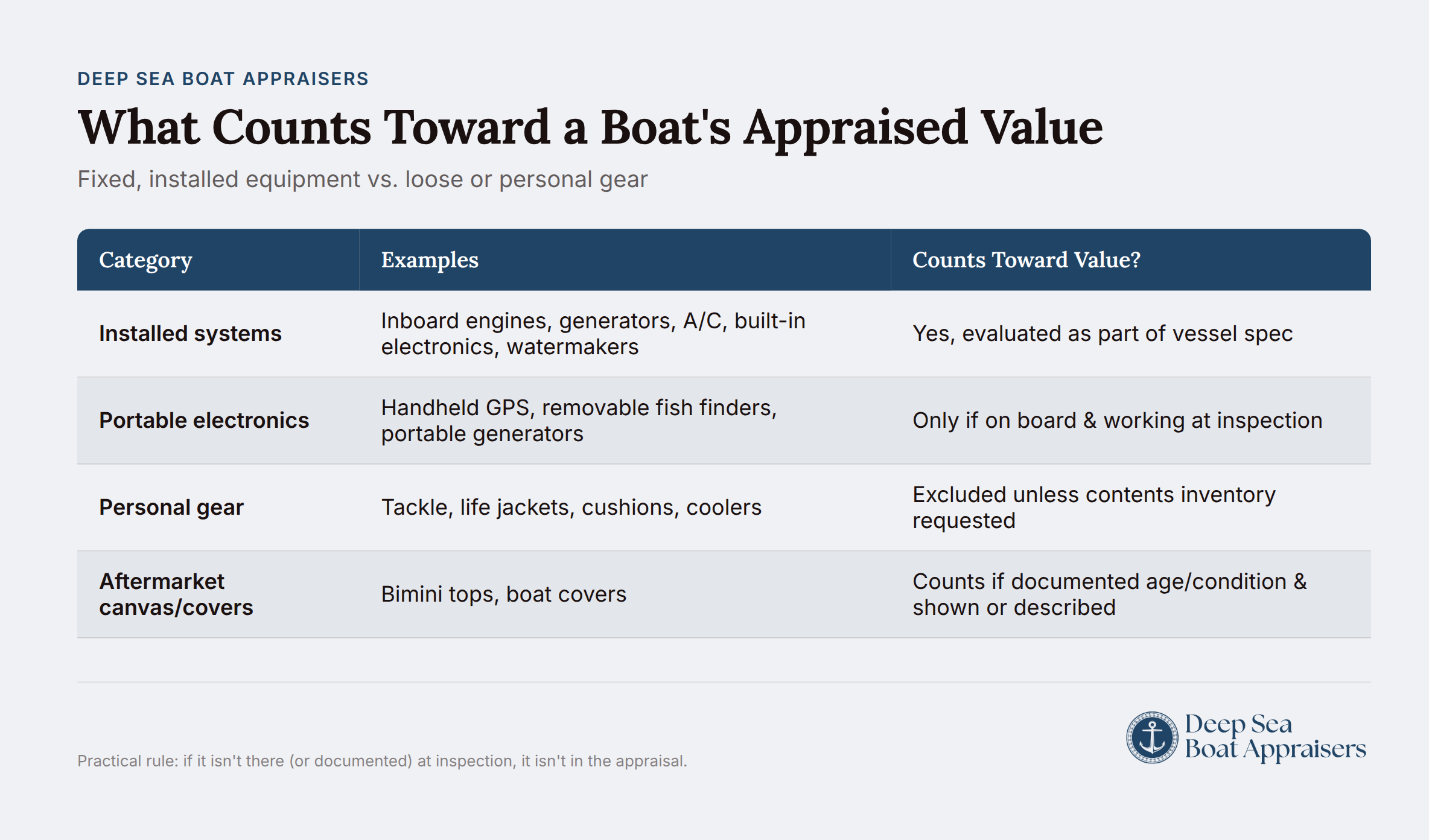
The first question our appraisers ask is simple: is this item installed and conveyed with the vessel, or is it portable property that could walk away with the seller? Fixed, documented, operational equipment that's included in the sale is treated as part of the vessel. Loose or removable items only get counted if they're present and verified at the time of inspection.
- Installed systems (inboard engines, generators, air conditioning, built-in electronics, plumbed watermakers) are evaluated as part of the vessel's condition and specification, similar to how production pleasure craft are valued against used-boat price guides that build in standard equipment levels.
- Portable electronics (handheld GPS units, removable fish finders, portable generators) only contribute value if they're on board and functioning during the inspection; a receipt for a unit that's been sold or moved to another boat doesn't support a value adjustment.
- Personal gear (fishing tackle, life jackets stored below, cushions, coolers) is typically excluded from the vessel's appraised value entirely unless the assignment specifically calls for a contents inventory.
- Aftermarket canvas and covers count as contributory value when their age and condition are documented, but a bimini that's been removed for winter storage needs to be shown to the appraiser or described in writing to be considered.
The practical rule: if it isn't there when the appraiser inspects the boat, it isn't in the appraisal. Owners who assume otherwise are often disappointed when a report doesn't reflect an upgrade they made months earlier but can't document or show.
Why a Boat Trailer Gets Its Own Value Line
A boat trailer is a separately titled asset, and it gets its own line in the appraisal report rather than being folded into the vessel's value. Trailers typically carry their own title, VIN, and registration, distinct from the hull identification number on the boat itself. Treating a trailer as an extension of the boat's value, rather than as its own line item, is one of the more common mistakes in informal valuations.
This separate-asset convention matters for a few practical reasons:
- Depreciation runs on a different schedule. A trailer's axles, tires, bunks, and frame wear and corrode differently than a hull, engine, or electronics package, so lumping the two together understates or overstates one or the other.
- Insurance and lending uses often require it. A lender securing a loan against the vessel, or an insurer writing a policy, may need the trailer's value broken out because it's collateral in its own right.
- Sales and estate contexts benefit from clarity. When a boat and trailer are later sold or distributed separately, a report that already separates the two values avoids a second valuation exercise.
Owners preparing for an appraisal should have the trailer's title, VIN plate, and any recent tire, bearing, or brake service records on hand, the same way they'd gather maintenance records for the boat itself.
How Electronics Upgrades Affect Contributory Value
Electronics are valued on contributory value, not replacement cost, meaning a recent upgrade adds what the market will pay for it today, not what the owner paid to install it. A new multifunction display, radar, or autopilot can meaningfully improve a boat's desirability, but technology in this category becomes outdated quickly, and buyers in the comparable market discount accordingly.
Our appraisers weigh three factors when assigning contributory value to an electronics package:
- Age and remaining useful life. A chartplotter installed last season carries more contributory value than the same model installed five years ago, even if both are functioning normally.
- Condition and integration. Equipment that's properly wired, networked, and functioning as designed supports a stronger adjustment than gear that's been added haphazardly or shows signs of water intrusion or corrosion.
- Comparable market evidence. Standard valuation guides build manufacturer, model, and specified equipment into a baseline retail estimate, and historical guide methodology has also assigned separate dollar adjustments for optional equipment drawn from dealer, broker, and used-boat market data. A surveyor then compares the subject boat against similar equipped vessels rather than treating the original purchase receipt as the value.
Example: An owner installs a $4,500 radar and autopilot package. Two years later, comparable boats with similar electronics are commanding $1,800 to $2,200 more than otherwise identical boats without them. The appraisal reflects the $2,000 contributory value the market actually supports, not the original invoice.
Pro tip: Keep the installation invoice, the serial numbers, and any firmware or service records for electronics upgrades. Documentation doesn't guarantee a particular dollar adjustment, but it gives the appraiser something concrete to weigh against comparable sales, and it removes guesswork from the inspection itself. For related reading on how equipment and usage factors are weighed, see our discussion of how engine hours shape appraised value.
Safety Gear: A Compliance and Condition Factor, Not a Value Driver
Safety and navigation equipment (life jackets, flares, fire extinguishers, EPIRBs, bilge pumps) mainly affects whether a boat is marketable and compliant, not how much a buyer will pay above a comparable vessel. Required or expected safety gear helps establish that a boat is usable and sellable as-is, but buyers generally treat it as part of a normal, functional specification rather than a premium feature.
Watch out: Missing or expired safety equipment can still hurt a report. If a boat shows up to inspection without a required fire extinguisher, outdated flares, or a non-functioning bilge pump, that can be noted as a condition issue or a cost-to-cure item, even though having the gear in good order wouldn't have added a comparable premium. In other words, safety gear carries more downside risk than upside value.
This is one reason appraisers distinguish between market value (what a buyer would actually pay, considering comparable sales, condition, and equipment) and replacement cost (what it would cost to replace an item new). A full suite of current safety gear supports marketability and may be required for certain insurance or lending purposes, but it rarely moves the needle on fair market value the way a repower or electronics upgrade can.
What to Disclose and Document Before the Appraiser Arrives
Owners who gather their records in advance get a faster inspection and a report that more accurately reflects what they've actually invested in the vessel. A disclosure and documentation checklist before the appraiser's visit should include the following:
- Itemize every piece of installed and portable equipment. List make, model, installation date, and serial number where available for engines, electronics, generators, and major systems.
- Separate the trailer's paperwork from the boat's. Have the trailer's title, VIN, and service records ready as their own file, not mixed in with the vessel's documentation.
- Pull maintenance and service records. Engine service logs, haul-out records, and any recent repairs support both condition assessments and contributory value for upgrades.
- Confirm what's actually on board. Walk the boat before the inspection and remove or disclose anything that won't be part of the sale or the appraisal's scope, so there's no confusion about what's being valued.
- Flag modifications and custom work. Extensive aftermarket modifications, canvas work, or non-factory installations are exactly the kind of equipment that standard pricing guides don't capture well, and they're worth describing in writing with dates and costs.
- Note safety equipment status. Confirm expiration dates on flares and fire extinguishers and that required gear is aboard and functional, since gaps here are more likely to show up as deductions than additions are to show up as premiums.
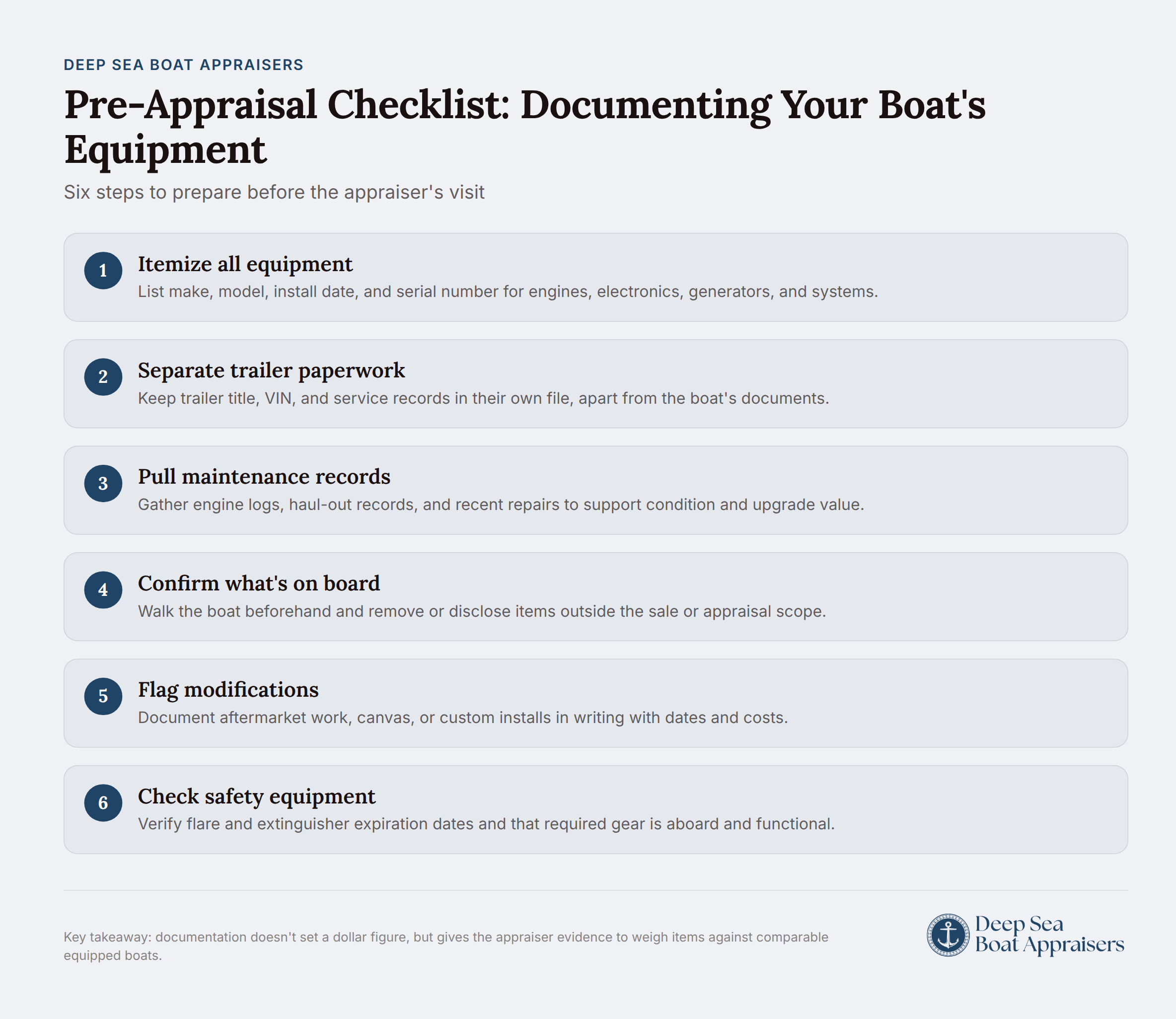
Key takeaway: Documentation doesn't buy a specific dollar amount. It gives the appraiser the evidence needed to weigh each item against comparable equipped boats and arrive at a defensible number.
Why This Distinction Matters for the Final Report
Appraisal purpose shapes how all of this gets applied. A boat being valued for an insurance claim or coverage decision may call for a different treatment of equipment than one being valued for a sale, an estate settlement, or a loan. For sales-comparison based reporting, which is the standard approach used for most production pleasure craft, our appraisers lean on comparable equipped vessels rather than invoices or guide-book sticker prices alone. Government personal property tax guidance follows a similar logic: assessors look to comparable sales of similar boats, and in jurisdictions that use a cost approach for personal property, original cost is adjusted for the item's economic life and depreciation rather than taken at face value.
Reports prepared in accordance with USPAP (the Uniform Standards of Professional Appraisal Practice maintained by The Appraisal Foundation) are built to withstand this kind of scrutiny, whether the reviewing party is an insurer, a lender, a court, or a tax authority. Many marine appraisals also draw on inspection standards associated with marine surveyor credentials such as NAMS and SAMS, particularly for hull and systems condition, alongside the appraisal methodology itself.
Getting Ready for Your Appraisal
The owners who get the most accurate reports are the ones who treat documentation as part of the appraisal, not an afterthought. Gather the equipment list, separate the trailer paperwork, pull maintenance records, and be upfront about anything that isn't staying with the boat. Our appraisers quote every engagement as a fixed fee after scoping the vessel and its equipment, never billed hourly, so there are no surprises once the inspection is complete.
If you're preparing to sell, insure, settle an estate, or simply need a defensible number for a boat with recent upgrades, request an appraisal and our team will walk you through exactly what to have ready.
This article is provided for general informational purposes only and does not constitute legal, tax, or financial advice. Readers should consult a qualified attorney or CPA regarding their specific circumstances.